Comunidad
¡Comparte tus pensamientos, experiencias o preguntas y participa en discusiones sobre nuestro tema favorito: el buceo!
Mensajes de:

-
 Ksso
Ksso -
 CMAS 3* VDST / N4
-
Titulaciones:
PADI Ice Diver, CMAS Nitrox 1, Photography -
Ha buceado en: Polinesia Francesa, Honduras, Jamaica, Netherlands Antilles, Estados Unidos, México, Portugal, España, República de Santo Domingo, Egipto, Tailandia, Grecia, Chipre, Francia, Indonesia
Kickstarter projects to watch
por Ksso el 08 de junio de 2011
Kickstarter is a platform to raise money for your project. Actually it's not really technicaly about raising money but rather about pre-selling the idea and getting enough cash to finance its execution. Kickstarter has helped finance and launch many amazing projects, sometimes geeky, sometimes arty... but today I wanted to showcase two projects related to things that matter to scuba divers.Living Sea Sculpture: contemporary art as coral refuge
Protei, Open Hardware Oil Spill Cleaning Sailing Robot
Both projects have been successfully founded, and we'll watch closely as they progress ! Hopefully we'll find more of such initiatives on Kickstarter.
Service disrupted : FB Graph API down
por Ksso el 06 de junio de 2011

Since about 12am CET, the FB Graph API which we rely on to authenticate Diveboard's users is massively disrupted as shown in the graph below. The graph is updated on Facebook Developer's blog page.
As a consequence almost no-one can login at the moment, until the API gets back to normal. I say almost no-one since there's a secret ugly page on diveboard to try out the login/password feature, and some users are actually using it. It's on occasions like this that we're happy to have cut the dependency with Facebook on that key element.UPDATE 1pm: After one hour downtime, API is back up at 1pm CET (lunch break over ?) - API is still VERY SLOW - fingers crossed !UPDATE 2pm: FB API is feeling...
Diveboard feature updates : Ready for non-fb-connect, Iterative permissions, Bulk dive manager
por Ksso el 03 de junio de 2011
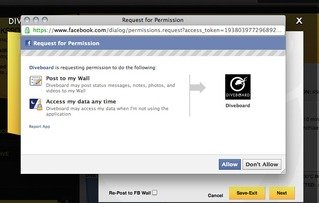
Finally ! We survived a complete rewrite of the login system. As you may have read previously, we assumed that diveboarders will be OK with the FB-login-only approach... apparently we were wrong since many of you actually were complaining about that.
Ready for non-fb-connect users & Iterative permissions
So we heard you and we spent a lot of time and effort to enable multiple login mechanisms on Diveboard. This came at a cost since FB Connect was doing a lot of the job, and we were given some capabilities such as you accessing your FB pictures/videos or posting to your wall were granted... and now we have to assume you may not even have a FB account ! So now we can handle those cases...
Coral Gardening in Fiji
por Ksso el 29 de mayo de 2011

Check out how marine biologists work with fishermen to regrow corals and restore reefs in the Pacific. It takes as much as 2 years for the coral to get to the stage where it can be harvested and re-planted on the reefs, this is what it takes to restore the habitat of the fishes and have them come back.Source Arthur Kerns via Chuck Jones
Fish round-up: Flying Gurnard
por Ksso el 28 de mayo de 2011

Flying gurnards are fast and sneaky. They camouflage on sandy bottom and the moment they feel they have been spotted they race their way away from you. I remember chasing one in Indonesia, Lombok at Meno Wall, and only managed to snap blurry pics after a few minutes of intense race.The Flying gurnards (Dactylopteridae) are fairly widespread as the GBIF map shows, yet they are fairly tough to spot usually (although apparently you now get a lot of those in Malta. They like to stay pretty deep (the oriental flying gurnard usually inhabits sandy bottoms at around 100m/330ft depth). The pectoral fins are normally held against the body, but when threatened the fins are expanded in to scare...
Fish round-up : the basking shark
por Ksso el 25 de mayo de 2011

While I never actually encountered one of those, basking sharks have fascinated me since I started scuba diving and learned about them. Basking sharks are the second largest living fish on earth, just after the whale shark.Wikipedia reports that the largest accurately-measured specimen was trapped in a herring net in the Bay of Fundy, Canada in 1851. Its total length was 12.27 metres (40.3 ft), and it weighed an estimated 19 short tons (17 t). Despite the fact that the beast is huge, it's perfectly harmless to humans : it's a slow mover that feeds by filtering water to catch plankton, small fish and invertebrates, basking in the warmer waters at the surface. The teeth in the basking shark...
What's up at Diveboard : login, home page and search by fish
por Ksso el 22 de mayo de 2011
I thought I'd drop a quick note about what's currently keeping us busy at Diveboard. There has not been a major update this week, not because we're slacking but because we're changing a few things at heart.
Login/Password
You've been so many complaining about the Facebook-connect-only login for the site, that we had to make the move and support the usual login/password methods. This is not an easy change since it has also big impact on the design and adds more flows (reset password, change password...) which were previously simplified by the use of Facebook connect. But we're getting there !New homepage ...
Fish round-up : the Doplhinfish
por Ksso el 20 de mayo de 2011

Dolphinfishes are fairly big creatures (often over 1m) from the family of ray-finned fish. The family has only one genus, Coryphaena, which contains two species, the "Mahi-Mahi" and "Pompano Dolphinfish". They are unrelated to dolphins as they are no mammals.Mahi-mahi means very strong in Hawaiian. Mahi-Mahis can live up to 4 years, weight up to 18kg (40 lbs) and measure up to 2m and are usually bigger than Pompano Dolphinfishes which are often mistaken with teen Mahi-Mahis.Mahi-mahi can be found in the Caribbean Sea, on the west coast of North and South America, the Pacific coast of Costa Rica, the Gulf of Mexico, the Atlantic coast of Florida, Southeast Asia, Hawaii and many other...
Fish round-up: deep-sea "Tortugas Red" jellyfish
por Ksso el 16 de mayo de 2011

As I was researching jellyfishes, I ended up gazing on this "Tortugas red" species. As you may have realized, jellyfishes are usually transparent-ish. They can be bioluminescent, they can diffract the light creating rainbow effects... but a red jellyfish that's something really rare.The Tortugas red is part of the "Ctenophora" phylum (one of the 40 divisions of the animalia kingdom) and populates cold waters all over the globe. It lives in deep water which is probably what got it its strong pigmentation.Unfortunately, not much is know about this species that has not even been properly described. The picture above is one of the few proving its existence and dates back from 1984 in Boreal...
The Race to inner space - Triton 36000
por Ksso el 11 de mayo de 2011

Submersibles are really trendy these days. Probably since it's the 50th anniversary of the deepest dive by the Trieste, but in a short while we've had Richard Branson announcing Virgin Oceanic and now Triton submarines announcing their "Race to Inner Space".The press release reads:The world’s most advanced submarine company, Triton Subs,and high pressure glass fabricator Rayotek Scientific, have joined forces to design a full ocean depth submersible that will revolutionize man’s relationship with the deep ocean. With a planned descent rate of 500 feet per minute, the deepest spot in the ocean, at 35,800 ft., can be reached in approximately 75 minutes. The Triton 36,000 Full Ocean Depth...
Comparte tus experiencias y reflexiones, o haz alguna una pregunta |
| ESCRIBIR UN POST |
Únete a Diveboard

Categorías de Ksso
Últimas actualizaciones de Ksso
 Help Test The New Diveboard And Raise More Funds!
por Ksso el 25 de abril de 2023 Getting Ready For Diveboard V2 Join Our Discord
por Ksso el 08 de septiembre de 2021 Try Out The Beta Android App
por Ksso el 28 de agosto de 2020 New Release Of The Diveboard Dive Computer Agent
por Ksso el 26 de noviembre de 2018 Diveboard Connects With Movescount Check It Out And Win !
por Ksso el 22 de junio de 2015
Posts más antiguos de Ksso
- abril 2023 (1)
- septiembre 2021 (1)
- agosto 2020 (1)
- noviembre 2018 (1)
- junio 2015 (1)
- diciembre 2014 (1)
- octubre 2014 (1)
- agosto 2014 (1)
- mayo 2014 (1)
- abril 2014 (1)
- marzo 2014 (1)
- enero 2014 (1)
- noviembre 2013 (3)
- octubre 2013 (1)
- septiembre 2013 (3)
- agosto 2013 (1)
- julio 2013 (2)
- junio 2013 (2)
- abril 2013 (1)
- marzo 2013 (1)
- febrero 2013 (2)
- enero 2013 (2)
- diciembre 2012 (2)
- noviembre 2012 (6)
- septiembre 2012 (1)
- agosto 2012 (2)
- julio 2012 (3)
- junio 2012 (1)
- mayo 2012 (3)
- abril 2012 (1)
- marzo 2012 (7)
- febrero 2012 (1)
- enero 2012 (5)
- diciembre 2011 (3)
- noviembre 2011 (3)
- octubre 2011 (8)
- septiembre 2011 (3)
- agosto 2011 (10)
- julio 2011 (4)
- junio 2011 (8)
- mayo 2011 (13)
- abril 2011 (6)
- marzo 2011 (10)
- febrero 2011 (15)
- enero 2011 (9)
 Estamos participando en el concurso de startups Techcrunch Disrupt. Apoya Diveboard votando por nosotros!